












CONTINUOUS IMPROVEMENT

Turn Every Improvement Into What Comes Next

Connect insight, business context, change, and performance to create a continuous improvement cycle that keeps your organization learning, adapting, and improving.

TRUSTED BY ORGANIZATIONS MANAGING
COMPLEX PROCESSES AT SCALE

  • Jabra
  • Salvation Army-1
  • Zeppelin-Cat
  • JM Family
  • Carglass
  • Cargill
  • Cegeka
  • schiphol-logo-grey
  • Dominos
  • Mondelez
  • Accenture
  • Port-of-Rotterdam
THE IMPROVEMENT GAP

Improvement Often Stops Between Insight and Execution

Organizations rarely lack ideas for improvement. The challenge is turning insight into coordinated change, embedding better ways of working, and using the results to drive what improves next. Too often, that cycle breaks:

Insights without action

Opportunities are identified but struggle to move into coordinated change.

Change without context

Improvements are made without understanding wider dependencies and impact.

Execution without consistency

Better ways of working are difficult to embed across teams and locations.

Results without continuity

Performance is measured, but learning does not feed the next improvement cycle.


 Continuous improvement means keeping that cycle moving. 

Proceswiel met zes pijlers
CONNECT THE CONTEXT

Continuous Improvement Is a Connected Management Discipline

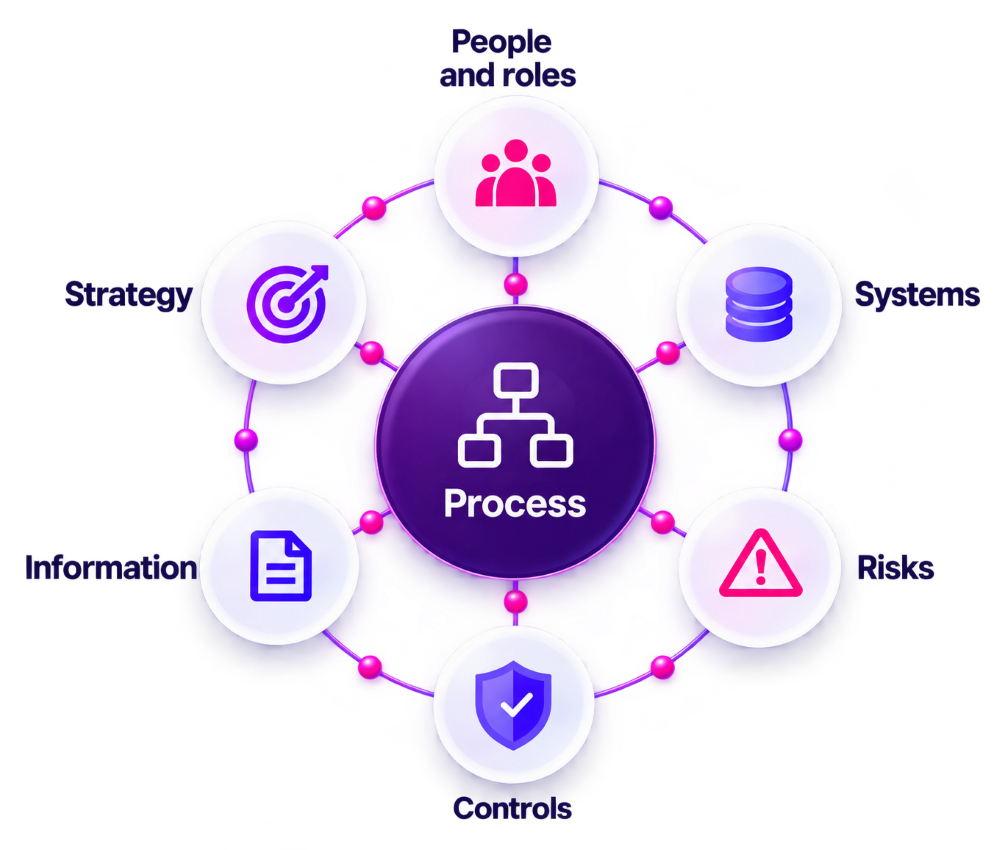
A process never operates in isolation. Every improvement can affect people, systems, responsibilities, risks, controls, and other processes across the organization.

Mavim connects that business context in a living model of how the organization operates and changes. Teams can see the opportunity, understand the wider impact, and improve with greater confidence.

See the opportunity. Understand the impact. Make the change. Measure what happens next.

A CONTINUOUS IMPROVEMENT CYCLE

Close the Loop Between Insight and Improvement

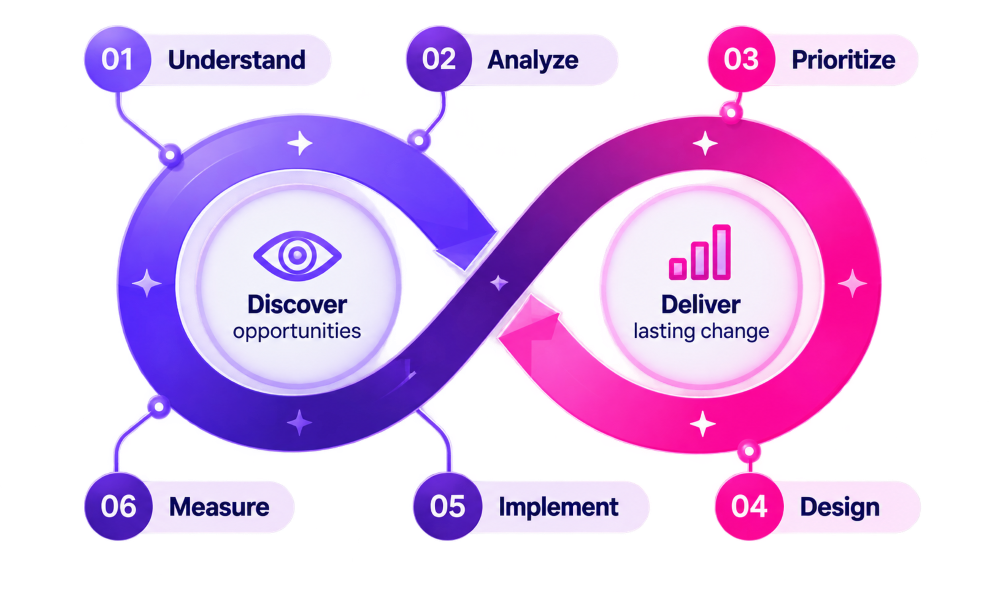
Continuous improvement works when insight leads to action, change becomes part of how people work, and results inform what happens next.

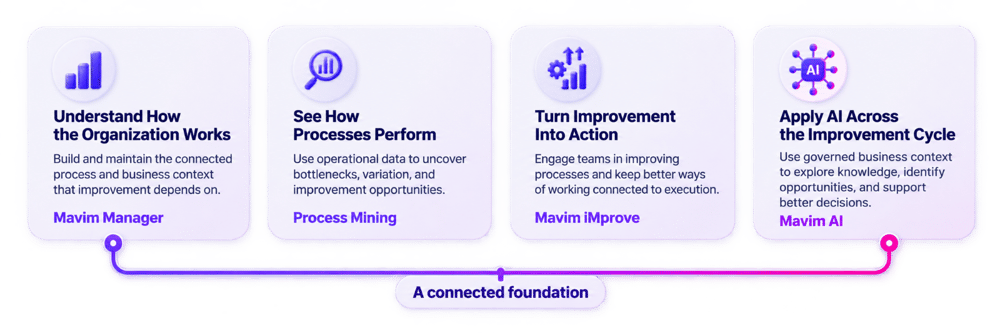
Mavim connects every stage in one continuous cycle:


 One connected cycle. From insight to improvement and back again.  

Oneindige innovatielus met zes stappen
FROM CYCLE TO CAPABILITY

Turn Improvement Into a Repeatable Way of Working

Continuous improvement needs more than a methodology. It needs a shared foundation that connects insight, decisions, change, and execution.

create-a-shared-operational-baseline

Create a Shared Operational Baseline

Connect processes with the people, systems, risks, controls, and performance context around them.

find-improvements-that-matter

Find the Improvements That Matter

Use process knowledge and performance insight to identify where change can make a difference.

turn-insigt-into-governed-change

Turn Insight Into Governed Change

Understand impact, define better ways of working, and translate decisions into coordinated change.

keep-improvement-moving

Keep Improvement Moving

Measure what changed, capture what was learned, and feed new insight into the next improvement cycle.

THE VALUE OF CONTINUOUS IMPROVEMENT

From Continuous Improvement to Lasting Impact

When improvement becomes a connected, repeatable way of working, organizations can move faster without losing context, control, or continuity.

number-1

Improve Faster

Move from opportunity to action with less friction.

number-2

Make Better Decisions

Understand dependencies and impact before making changes.

number-3

Execute More Consistently

Embed improved ways of working across teams and locations.

number-4

Sustain the Gains

Keep performance connected to learning and continuous improvement.

WHERE TO START

Apply Continuous Improvement Where It Matters Most

You do not need to improve everything at once. Start with an operational priority, connect the context around it, and expand as improvement becomes part of how the organization works.

Process Performance

Reduce bottlenecks, delays, rework, and unnecessary variation.

Standardization & Harmonization

Create more consistent ways of working across teams, locations, and business units.

Customer Experience

Connect customer outcomes to the processes and dependencies behind them.

Cost & Efficiency

Reduce unnecessary effort, handoffs, and operational waste.

Risk & Control

Improve execution while maintaining the controls that matter.

CONNECTED BY MAVIM

One Connected Foundation for Continuous Improvement

Continuous improvement depends on more than process documentation or performance insight alone.
Mavim connects the business context, operational evidence, improvement, and governance needed to keep the cycle moving.

Verbonden verbetering in vier stappen
CONTINUOUS IMPROVEMENT IN PRACTICE

From Process Visibility to Continuous Improvement

For Royal IHC, improving complex shipbuilding operations starts with understanding how work is performed across the organization.

With Mavim, teams gain a shared view of processes and how they connect across the business. This helps bring people together around better ways of working, identify opportunities for improvement, and make process knowledge accessible to the employees who need it.

See How Royal IHC Turns Process Visibility Into Better Ways of Working

Watch how Royal IHC uses Mavim to strengthen collaboration, improve process consistency, and support greater operational efficiency.

CONTINUOUS IMPROVEMENT RESOURCES

Go Deeper Into Continuous Improvement

Explore practical guidance on the principles, methodologies, and practices that help organizations turn Continuous Improvement into a sustainable way of working.

FREQUENTLY ASKED QUESTIONS

Continuous Improvement FAQs

Find answers to common questions about continuous improvement, process improvement, and how Mavim helps organizations turn insight into lasting change.

What is continuous improvement?

Continuous improvement is a structured approach to identifying, implementing, and measuring ongoing improvements to how an organization works. It connects performance insight with changes to processes, responsibilities, systems, and ways of working so improvement becomes a continuous cycle rather than a series of isolated projects.

What is the difference between continuous improvement and operational excellence?

Continuous improvement is the ongoing discipline of identifying and implementing improvements. Operational excellence is the broader goal of creating consistently effective, efficient, and resilient operations. Continuous improvement is one of the ways organizations work toward and sustain operational excellence.

How does Mavim support continuous improvement?

Mavim connects processes with the people, systems, risks, controls, performance insights, and changes around them. This shared business context helps teams understand how work happens today, identify opportunities, assess impact, implement improvements, and measure what happens next.

How does process mining support continuous improvement?

Process mining uses operational data to show how processes actually execute and where bottlenecks, delays, rework, or variation occur. Combined with business context, these insights help teams determine what needs improvement and understand the wider impact of proposed changes.

How can organizations sustain continuous improvement?

Sustained improvement requires a repeatable cycle that connects insight, decisions, implementation, governance, and measurement. Organizations also need clear ownership and a shared view of how changes affect processes, people, systems, risks, and controls.

How can AI support continuous improvement?

AI can help teams explore process knowledge, identify patterns and improvement opportunities, and access relevant business context faster. When AI works from governed organizational context, it can support improvement decisions while keeping recommendations grounded in how the organization actually operates.

START IMPROVING

Make Improvement Part of How Your Organization Operates

Connect insight, business context, change, and performance in one continuous cycle, so every improvement creates the foundation for what comes next.